5 Game-Changing Algorithms That Power Modern Technology
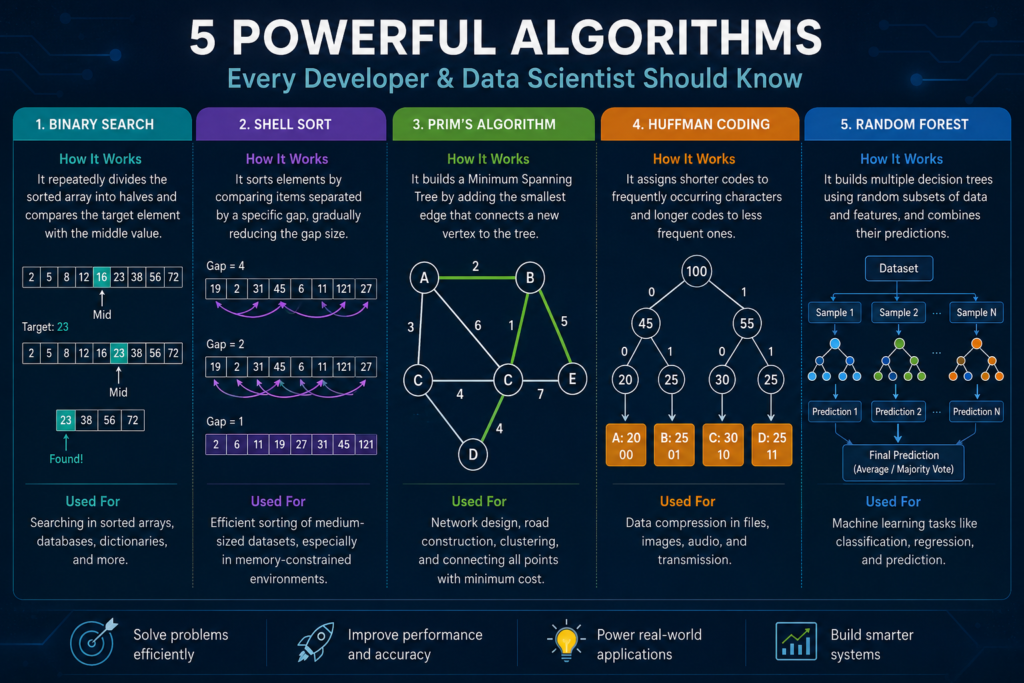
Algorithms are the foundation of modern computing, helping computers solve problems efficiently and process data effectively. From searching information in databases to building intelligent machine learning models, algorithms play a crucial role in technology. In this blog, we will explore five important algorithms: Binary Search, Shell Sort, Prim’s Algorithm, Huffman Coding, and Random Forest.
1. Binary Search
What is Binary Search?
Binary Search is a fast searching algorithm used to find an element in a sorted dataset. Instead of checking every item one by one, it repeatedly divides the search space into halves.
How It Works
- Find the middle element of the sorted list.
- Compare the target value with the middle element.
- If they match, the search is complete.
- If the target is smaller, search the left half.
- If the target is larger, search the right half.
- Repeat until the element is found or the list is exhausted.
Purpose
The primary purpose of Binary Search is to reduce search time and improve efficiency.
How It Is Used
- Database indexing
- Dictionary and contact searches
- E-commerce product searches
How to Handle It
Always ensure the data is sorted before applying Binary Search. If the data is unsorted, the algorithm will not produce accurate results.
2. Shell Sort
What is Shell Sort?
Shell Sort is an improved version of Insertion Sort that sorts elements by comparing items separated by a specific gap.
How It Works
- Start with a large gap between elements.
- Compare and sort elements within the gap.
- Gradually reduce the gap size.
- Continue until the gap becomes 1.
- Perform a final insertion sort.
Purpose
Shell Sort aims to improve sorting performance by reducing the number of shifts required compared to traditional insertion sorting.
How It Is Used
- Medium-sized datasets
- Embedded systems
- Applications requiring simple and efficient sorting
How to Handle It
Choose an appropriate gap sequence to achieve better performance. Different gap sequences can significantly affect sorting efficiency.
3. Prim’s Algorithm
What is Prim’s Algorithm?
Prim’s Algorithm is a graph-based algorithm used to find the Minimum Spanning Tree (MST) of a connected weighted graph.
How It Works
- Start with any node in the graph.
- Select the smallest weighted edge connected to the current tree.
- Add the connected node to the tree.
- Repeat until all nodes are included.
Purpose
The purpose of Prim’s Algorithm is to connect all nodes with the minimum possible total edge weight.
How It Is Used
- Network design
- Road and railway planning
- Telecommunication infrastructure
How to Handle It
Ensure the graph is connected and edge weights are properly defined. Priority queues can be used to improve efficiency in large graphs.
4. Huffman Coding
What is Huffman Coding?
Huffman Coding is a lossless data compression algorithm that reduces file size by assigning shorter codes to frequently occurring characters.
How It Works
- Count the frequency of each character.
- Create a binary tree based on frequencies.
- Merge nodes with the smallest frequencies repeatedly.
- Generate binary codes from the tree structure.
- Replace characters with their corresponding codes.
Purpose
The main purpose is to compress data without losing information.
How It Is Used
- ZIP file compression
- Image compression
- Multimedia transmission
How to Handle It
Accurate frequency calculation is essential for effective compression. The generated Huffman tree must be preserved for proper decompression.
5. Random Forest
What is Random Forest?
Random Forest is a machine learning algorithm that combines multiple decision trees to improve prediction accuracy and reduce overfitting.
How It Works
- Create multiple random samples from the dataset.
- Build a decision tree for each sample.
- Make predictions using all trees.
- Combine the results through voting (classification) or averaging (regression).
Purpose
The goal of Random Forest is to produce more accurate and reliable predictions than a single decision tree.
How It Is Used
- Customer behavior prediction
- Fraud detection
- Medical diagnosis
- Recommendation systems
How to Handle It
Properly prepare and clean the dataset before training. Adjust parameters such as the number of trees and tree depth to achieve optimal performance.
Conclusion
Binary Search, Shell Sort, Prim’s Algorithm, Huffman Coding, and Random Forest each serve unique purposes in computer science. Binary Search improves searching efficiency, Shell Sort enhances sorting performance, Prim’s Algorithm optimizes network connections, Huffman Coding reduces storage requirements, and Random Forest strengthens predictive analytics. Understanding how these algorithms work and where they are applied helps developers and data professionals build faster, smarter, and more efficie